Final UCAT ANZ 2026 Test Statistics and Percentile Calculator Released!
Posted: September 09, 2026 by Chris
The UCAT ANZ 2026 percentile calculator and final statistics have been released, which will help students to interpret their UCAT 2026 scores.
The UCAT consortium has developed a UCAT score to percentile calculator that will help you to convert your 2026 UCAT scaled scores into an estimated percentile ranking. You can find it on the UCAT ANZ test statistics page.
The UCAT 2026 summary statistics data is available in the UCAT ANZ 2026 summary statistics PDF.
What data is shown?
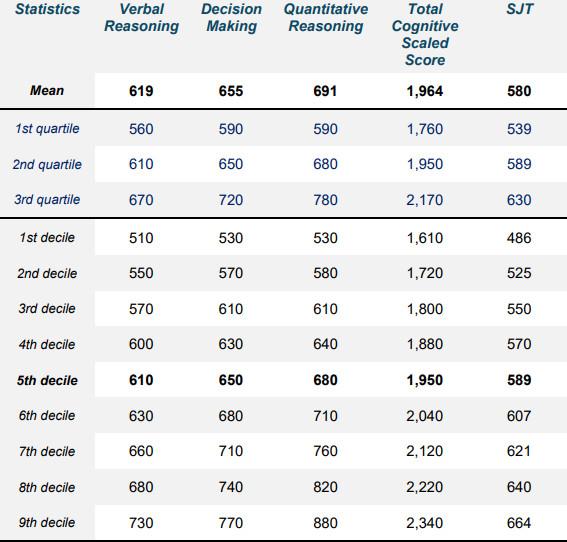
The UCAT ANZ 2026 test statistics displays the following data:
- the mean scores for each UCAT subtest
- the mean overall UCAT cognitive score
- the UCAT scores required to achieve a particular decile for each UCAT subtest
- how overall UCAT cognitive scores translate to percentiles
- UCAT candidate performance expressed in quartiles
The data is based on the scores of the 17,341 candidates who sat UCAT ANZ in the 2026 testing cycle.
What does the data mean?
Here's what these figures look like in context: if, for example, you achieved a UCAT Quantitative Reasoning score of around 680, your score was about average (5th decile) compared to other candidates sitting UCAT ANZ 2026. On the other hand, if you achieved a UCAT Decision Making score of around 770, you will have achieved the 9th decile, that is, you will have been in the top 10% of candidates for this UCAT subtest.
In general, to obtain an interview offer for a standard, non-rural place in medicine, you'll need an overall cognitive UCAT score in the 9th decile, the top 10% of students sitting UCAT. In 2026, that threshold equates to an overall UCAT cognitive score of 2340+ (out of 2700). This represents an increase from 2025, where an overall UCAT score of approximately 2310 would have placed you in the 9th decile.
Note: your own total cognitive score is your Verbal Reasoning, Decision Making and Quantitative Reasoning scaled scores added together. However, the total cognitive scaled score for a given decile in the Summary Score Statistics isn't calculated by adding together that decile's individual subtest scores. It's calculated separately, from the distribution of total scores across all candidates
How can I calculate my UCAT percentile?
You can find a UCAT percentile calculator on the UCAT ANZ website. Enter the total of your UCAT Verbal Reasoning, UCAT Decision Making, and UCAT Quantitative Reasoning scores to find out your percentile.
What interpretations can be made from the UCAT 2026 test statistics?
This UCAT data shows that students who achieved an overall scaled score of 2340+ were in the 90th percentile, which is generally required for entry into standard undergraduate medical degrees (UCAT scores required are generally lower for rural students, local students, bonded students, some dentistry courses and those with very high ATARs).
Historical 90th percentile trend
The UCAT total cognitive scaled score required to be in the 90th percentile has been gradually increasing:
- In 2020, you needed 2920 to achieve 90th percentile
- In 2021, you needed 2960
- In 2022, you needed 2980
- In 2023, you needed 3000
- In 2024, you needed 3060
- In 2025, you needed 2310
- In 2026, you needed 2340 to achieve 90th percentile
Note: The Abstract Reasoning subtest was removed from the UCAT in 2025, changing the total cognitive score scale from four subtests (a possible total of 3600) to three (a possible total of 2700).
This is because medicine is getting more competitive every year, and also reflects the greater preparation by the cohort of UCAT students each year. Since Abstract Reasoning was removed in 2025, students have also had more scope to focus their preparation on the remaining three cognitive subtests.
Median scores have only had a slight increase over the years. This implies that it is getting more competitive at the top end of the UCAT distribution, where interview offers are decided.
How each subtest shifted in 2026
Compared to 2025, the 90th percentile UCAT scores have remained stable for UCAT Verbal Reasoning (730 vs 730) and UCAT Quantitative Reasoning (880 vs 880). UCAT Decision Making has increased (770 vs 750), while UCAT Situational Judgement has decreased slightly (664 vs 672). These shifts may reflect changes in the relative proportion of students' preparation effort directed at each subtest, alongside natural year-on-year variation in cohort performance and test difficulty calibration.
The mean (average) UCAT ANZ scaled score (total of the cognitive subtests) increased from 1941 in 2025 to 1964 in 2026, a rise of 23 points, suggesting a modest overall uplift in cohort performance across the cognitive subtests.
The mean UCAT Situational Judgement score was 580 (down from 586 in 2025), and a score of about 664 (672 in 2025) equated to the 90th percentile.
What score do I need to get into medicine?
The UCAT score required for entry into medicine depends on a number of factors, including the university and course to which you are applying, whether you are a rural applicant and whether you are a local applicant (for example for the University of Western Sydney). Rural students require significantly lower UCAT scores to obtain entry into medicine.
In general, for standard, non-rural applicants to medical courses in Australia, you will need to be in the top 10% of students sitting UCAT to be considered for interview offer. At some universities, offers for medicine are made for students who perform outstandingly well in their ATAR.
Note that James Cook University and Bond University do not require you to sit UCAT for entry into medicine.
What should I do now?
Your next step depends on your score, your ATAR, and the university and pathway you're applying for. A strong score puts you in a good position for an interview offer. A score that falls just short of that range doesn't necessarily rule an offer out either, particularly for rural applicants or those expecting a high ATAR. For further guidance based on your score, see our blog, UCAT ANZ Score Advice: What Should You Do Now?
If you are likely to receive an interview offer based on your UCAT score, you should start preparing for interviews as soon as possible.
Last updated: September 2026


